Confined spaces, or rather confined environments, are regulated by Legislative Decree 81/08 with references to circulars mentioned in the consolidated text on safety and references in Presidential Decree 177/2011, the latter is valid until the definition of an overall qualification system for companies and self-employed workers.
In particular, the first general decree provides that entry into a confined environment can take place only after receiving specific training and being equipped with adequate personal protective equipment (PPE).
It is also necessary to verify that an examination has been carried out by a competent doctor on the health of the workers concerned and that measurements of the air quality within the confined space have been carried out.
In addition, it is mandatory to carry out a preliminary risk analysis, establishing criteria and modalities for emergency interventions. Workers must be trained in the safe use of equipment and motivated to comply with safety standards.
In conclusion, the law regulating confined spaces establishes that workers must be adequately trained on safety and equipped with appropriate personal protective equipment, as well as that medical checks and preliminary risk analyses have been carried out before entering a confined environment.
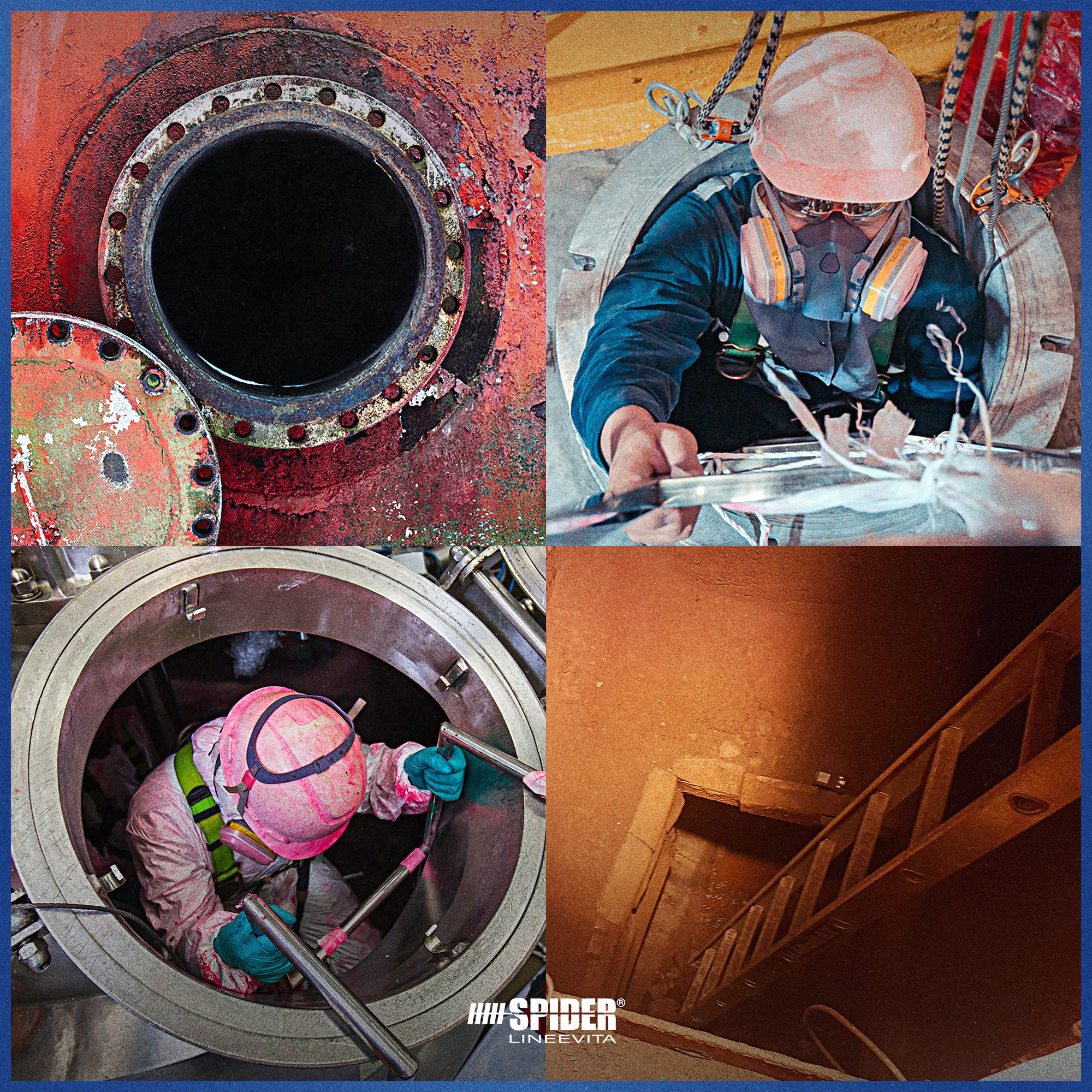
Legislative Decree no. 81 of 9 April 2008 (also known as the Consolidated Law on Safety at Work) defines confined environments as “closed spaces, both open and watertight, in which a person may be exposed to safety and health risks during the performance of work”. These spaces can be hazardous due to oxygen-deficiency, explosive or toxic atmospheres, high ambient temperatures, or contaminants. There are also special risks associated with the isolation and limited accessibility of confined spaces. Presidential Decree 177/2011 defines the minimum safety measures to be adopted in work activities carried out within confined environments. The Decree provides for general prevention and protection procedures including: risk assessment before starting any activity, specific training for all workers entering a confined environment, protective equipment appropriate to the type of risk present and periodic inspections of confined spaces. The main objective of Presidential Decree 177/2011 is to ensure the health and safety of workers in the confined environment, providing them with all the necessary means to carry out their work in safe conditions.
The legislation on confined spaces applies to all those who wish to access a delimited space, including workers, employees, volunteers and visitors. It is important to note that this regulation is not limited only to work environments, but is also extended to all other confined spaces such as storage, basements and cellars.
In particular, the legislation aims to prevent fatal accidents and serious injuries in carrying out activities within a delimited space. To ensure the safety of users, the law establishes precise procedures to be followed before entering such an environment. These measures include risk analysis, assessment of the area, installation of appropriate safety equipment and training of the personnel involved.
In addition, it provides that every person authorised to enter a confined space must be equipped with the necessary equipment to ensure the highest possible level of personal protection. Such devices include gas masks, protective helmets, abrasion-resistant gloves and waterproof boots. The law also provides for specific training requirements for persons entering a defined environment and obligations to provide health and safety information from the employer.
In conclusion, the legislation on confined spaces applies to any individual wishing to gain access to such an environment. Understanding this regulation is essential to ensure the health and safety of the user in the confined space in question.
Workers working in confined spaces must attend a mandatory training course before starting their activity. This course has been introduced to avoid dangerous situations and encourage compliance with safety regulations.
The main objectives of the course are to provide information on risk prevention and the practice of safety in the workplace, as well as to educate workers on preventive measures to be taken to avoid accidents. In addition, the course will provide detailed instructions on how to wear and handle personal protective equipment (PPE).
During the course, participants will learn to recognize the risks present in confined spaces, such as lack of oxygen, the presence of harmful gases, high levels of humidity or heat, electrical or chemical explosions and other factors that can put the health of operators at risk.
Detailed instructions on how to deal with such dangerous situations and avoid negative consequences will also be provided. In addition, you will learn how to prepare before entering the confined space and carry out periodic checks during the performance of the activities in order to ensure a safe and productive environment.
Compulsory training is a fundamental step to ensure the safety of human life and the surrounding environment. Therefore, everyone who works in confined spaces must follow a specific course to ensure that they have acquired the necessary knowledge to prevent accidents and injuries in the workplace.
If you need information regarding courses on confined spaces or related to it Contact us!
In everyday language, these are commonly referred to as confined spaces, but Italian legislation frequently uses the term environments suspected of contamination, and more broadly, places where there may be a serious risk related to the internal atmosphere (oxygen deficiency, toxic gases/vapours, explosive atmospheres). The key point is that it is not simply a matter of the space being “enclosed”: what matters is that the environment can quickly become dangerous, and that the conditions for access, egress and ventilation make intervention, and above all rescue, more difficult.
Article 66 of Legislative Decree 81/08 governs access to and work in places where harmful gases may be released (e.g. cesspits, sewers, pits, ducts, boilers and similar structures) and imposes strict precautions: verification/decontamination of the atmosphere, effective ventilation and, where there is doubt as to the level of danger, continuous supervision and measures enabling the operator to be rescued.
For temporary or mobile construction sites, Article 121 reinforces this requirement: where there is concern about the presence of toxic or asphyxiating gases, or unbreathable air, and complete ventilation and decontamination cannot be guaranteed, suitable respiratory PPE, rescue systems and external supervisory personnel are required.
Presidential Decree 177/2011 clarifies that its scope also includes the “confined spaces referred to in Annex IV, point 3, of Legislative Decree 81/08”. This is one of the reasons why, in practice, this is regarded as an interlocking regulatory framework (Articles 66 + 121 + Annex IV).
Presidential Decree 177/2011 is the central reference point where work in environments suspected of contamination or confined spaces is entrusted to companies or self-employed workers: it establishes that such activities may only be carried out by qualified parties, introducing organisational requirements (emergency management, risk assessment, health surveillance, etc.).
In 2025, the State-Regions Agreement of 17 April 2025 (Official Gazette No. 119 of 24 May 2025) was published, setting out the minimum duration and content of health and safety training courses under Article 37 of Legislative Decree 81/08. This is a key reference for anyone researching confined space safety, as it introduces more consistent and verifiable training requirements.
On a technical and operational level, UNI 11958:2024 provides criteria for identifying hazards and assessing risks in confined spaces and/or environments suspected of contamination, with an approach geared towards the classification/mapping of environments, activity planning, and prevention and protection measures.
Confined spaces are dangerous because the risks can be immediate and are often not perceptible (e.g. oxygen deficiency, odourless gas). The main scenarios to be managed include:
The main operational requirements for safety in confined spaces are:
To genuinely reduce risk (and liability), a technical partner should not just sell PPE, but guarantee a complete process. This is why at SPIDER we handle:
There is no single law: the main references are Legislative Decree 81/08 (Article 66 and Article 121 + Annex IV) and Presidential Decree 177/2011; for operational support, the State-Regions Agreement of 17 April 2025 (training) and UNI 11958:2024 (risk assessment) are also relevant.
It introduces a qualification system for companies and self-employed workers operating in environments suspected of contamination or in confined spaces, requiring organisational and management requirements (including risk assessment, emergency management and health surveillance)
The most frequently cited are Article 66 (environments suspected of contamination) and Article 121 (construction site context), together with the scope of Annex IV referenced by Presidential Decree 177/2011.
It is a technical standard (not a law), but it is very useful, as it provides criteria and a method for identifying hazards and assessing risks in confined spaces/environments suspected of contamination: in practice, it helps make the process more robust and defensible.