Two layers of rules govern fall protection systems in the UK. Legislation, the Work at Height Regulations 2005, sets out legal duties for anyone who controls work at height. Technical standards, including BS EN 795, BS 7883, BS 8610 and BS EN 17235, define how anchor devices must perform, be installed and be inspected.
In this guide:
A fall protection system is a fall-arrest anchor device: a fixed or temporary installation that gives workers a secure connection point while operating at height. In the UK, fall protection systems are governed by two separate regulatory frameworks that are often confused with one another.
Confusing the two leads to a common mistake: assuming that meeting a technical standard is the same as being legally compliant. In practice, both need to be satisfied: the equipment must meet the standard, and its use must be planned, supervised and maintained in line with the Regulations.

The Work at Height Regulations do not impose a general requirement to install a fall protection system on every building or for every activity at height. A fall protection system becomes appropriate only where the risk assessment and hierarchy of control show that the work cannot be avoided and that collective fall-prevention measures are not reasonably practicable or do not provide sufficient protection.
There is no fixed height threshold in UK law. The Work at Height Regulations 2005 apply wherever there is a risk of falling a distance liable to cause personal injury, not only when working at significant elevation. Duty holders often assume the Regulations only cover roofs, scaffolding or ladders, but low-level tasks, such as working near an unguarded loading bay edge, or using steps to access shelving, can fall within scope just as much as roof access.
For any activity that meets this threshold, the person controlling the work must first consider whether the work at height can be avoided altogether. Where it cannot, collective protection (such as guardrails and walkways) must be prioritised over personal protection solutions like anchor systems, harnesses and lanyards, wherever reasonably practicable.
The Regulations apply to employers, the self-employed, and anyone who controls the work of others at height, including facilities managers and building owners who contract out maintenance work (Regulation 3). Their core duties include:
Regulation 6 sets out a clear order of priority that applies to every fall-protection decision:
The Work at Height Regulations 2005 also amend the Provision and Use of Work Equipment Regulations 1998 (PUWER) (Regulation 17). Where a fall protection or anchor system is provided for use at work, the duties under PUWER may also be relevant. These include ensuring that work equipment is suitable for its intended use, maintained in a safe condition and inspected where installation, deterioration or exceptional events could affect its safety.
Request a Technical Inspection of Your Fall Protection System
One of our qualified technicians will assess the condition of your system and identify any non-conformities before they become a risk.
REQUEST YOUR INSPECTIONThe relevant technical framework depends on the type and intended use of the anchor system. BS EN 795:2012 applies to temporary anchor devices within its scope. Permanent anchor systems have also traditionally been addressed in Great Britain through BS 8610:2017, while BS 7883:2019 provides recommendations for system design, installation, use, maintenance and inspection. BS EN 17235:2024 is the current British Standard specifically covering permanent anchor devices and safety hooks.
Within its scope, BS EN 795 classifies anchor devices into types, including:
BS EN 17235:2024 is the current British adoption of the European standard for permanent anchor devices and safety hooks. The standard was harmonised under the European Union Construction Products Regulation on 9 February 2026. This EU harmonisation should not be confused with designation under the construction-products regime applicable in Great Britain. Product marking and conformity-assessment obligations depend on the market in which the product is placed, whether Great Britain, Northern Ireland or the European Union, and on whether the relevant CE, UK or UKNI route is followed.
The required declaration and product marking depend on the market where the product is placed and on the conformity route adopted. Products placed on the EU market under the harmonised EN 17235 route are subject to the applicable Construction Products Regulation requirements, including the Declaration of Performance and CE marking. Separate rules apply to Great Britain and Northern Ireland.
Sources: The Work at Height Regulations 2005 (legislation.gov.uk), HSE — Work at height: the law
Installing a compliant fall protection system is only the first step. Under Regulations 12 and 13, work equipment and places of work at height must be inspected periodically to confirm they remain safe; a fall protection system that is not maintained cannot be assumed fit for use, regardless of how it was originally certified.
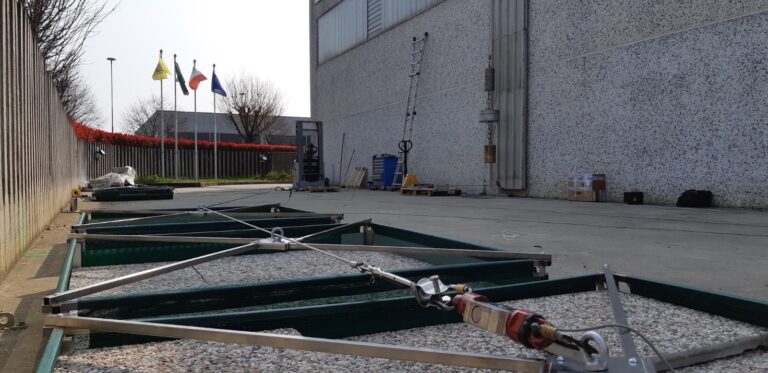
Fall protection systems are normally given a detailed inspection at intervals not exceeding 12 months, unless the manufacturer, system documentation, risk assessment or environmental conditions require a shorter interval. The Work at Height Regulations themselves require inspection at suitable intervals and following any exceptional event liable to affect the system’s safety.
Inspections must be carried out by a competent person: someone with the necessary training, knowledge and experience to identify defects and assess whether the system remains safe, as required under Regulation 5.
Inspection results must be documented and retained in accordance with the applicable legal and technical requirements. Although Schedule 7 of the Work at Height Regulations 2005 is not the universal statutory template for every permanent anchor-system inspection, its particulars provide a useful basis for a clear report. The report should identify:
Keeping this documentation isn’t a formality: it is what allows a duty holder to demonstrate compliance if the system is ever challenged or inspected by the HSE.
Falls from height remain the leading cause of workplace fatalities in the UK, and HSE enforcement in this area has intensified. Compliance is increasingly assessed as an ongoing duty rather than a one-off installation: inspectors expect up-to-date risk assessments, documented inspection records, and evidence of ongoing training, not just proof that a system was installed correctly at some point in the past. Missing documentation is treated as a compliance failure in its own right, even where the physical system appears in good condition.
Choosing Spider for the installation and maintenance of your fall protection system means working with a partner that manages the entire process to a structured, certified standard, not just formal compliance on paper.
Explore our full range of fall protection systems, installation and maintenance solutions for a complete overview of horizontal, vertical and rail-mounted options.
Request a Technical Inspection of Your Fall Protection System
One of our qualified technicians will assess the condition of your system and identify any non-conformities before they become a risk.
REQUEST YOUR INSPECTION